
Innovations in the Genetic Resistance of Apple Varieties to Apple Scab
Monogenic vs. polygenic: Which resistance strategy prevails in apple cultivation?
Apple scab, caused by the fungal pathogen Venturia inaequalis, is one of the most challenging diseases in apple production worldwide. It affects leaves, shoots and fruits, leading to reduced yield and fruit quality. Affected apples can be destined just to industry. Most of the commercial apple varieties are highly susceptible to scab. However, in the context of climate change, as well as the reduction in the number of fungicide active ingredients and stricter limits on residue levels in fruits produced and marketed in the European Union, conventional farmers increasingly integrating scab, powdery mildew and fire blight resistant varieties into their apple orchards. Organic fruit production relies even more on resistant varieties.
What is disease resistance?
Disease resistance is the genetic ability of a plant to withstand attack by a pathogen. The main resistance mechanisms could include the formation of physical barriers in plants, hypersensitive response by localized necrosis of infected cells, the formation of antimicrobial metabolites such as phytoalexins, phytoanticipins or proteins controlling the disease or strengthening the plant immune system. Resistance is sometimes mistakenly confused with immunity by the general public. In the case of resistance, the pathogen may partly overcome the host's defence reaction, but the resulting damage usually remains insignificant. In contrast, immunity means that the pathogen can never overcome the host's defence reaction. Immune varieties are not available on the market, since permanent immunity cannot be guaranteed.
History of the first resistant apple breeding programmes
Most apple breeding programmes, in addition to improving fruit quality and yield, also target resistance to scab.
The first commercial scab-resistant apple variety was Prima developed in 1970's in the Unites States, followed by Florina in France. Since the 1980s, the Institute of Experimental Botany in the Czech Republic has bred, for example, the variety Topaz. The Dresden-Pillnitz Institute in Germany developed the RE series of varieties, such as Reglindis, Remo and Rewena. Over 20 resistant genes have been identified, each originating from wild Malus species such as M. floribunda, M. micromalus, and M. baccata.
This resistance can be based on monogenic or polygenic inheritance.
Monogenic Resistance
If speaking about apple varieties, monogenic resistance is based on single, major resistance genes (historically called Vf, Vm, Vr, Vbj, etc.), now standardized under the Rvi nomenclature (Resistance to Venturia inaequalis).
The working mechanism provides a very strong, often complete protection: the plant recognizes Venturia inaequalis and triggers a hypersensitive response, causing cells around the infection site to die, preventing the fungus from establishment. However, this type of resistance is essentially a qualitative trait. It is effective against certain pathogen races but not others, since scab can mutate into new races that may be go unrecognized by the plant, leaving the defence mechanisms inactivated. If a variety with race-specific resistance is widely cultivated in a fruit-producing region or orchard where genetically identical plants are grown, the selection pressure from the pathogen is high, and the variety can become susceptible within a few growing seasons. In this case, the pathogen multiplication is rapid, and all plants may become diseased.
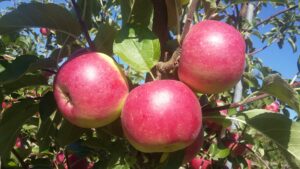
The Rvi6 is the most widely used resistance gene, derived from Malus floribunda 821. It provides strong resistance to scab, and many well-known resistant varieties (e.g., Topaz, Reglindis, Prima, Florina, Story Inored) carry this gene (Image 1). However, its durability has been challenged in the most apple producing regions where new pathogen races have overcome it.
Other genes: Rvi1, Rvi2, Rvi4, Rvi8, and Rvi11 are also incorporated into breeding programs. Some varieties, like Prima and Florina combine Rvi1 and Rvi6 for increased durability.
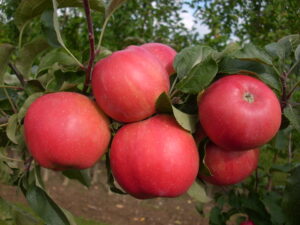
Image 1. Orange Crisp® UEB 6481 variety with Rvi6 scab resistance from UEB breeding programme. Source: Radek Černý (UEB)
Polygenic resistance
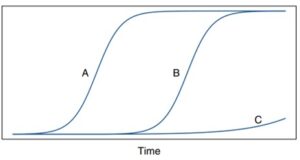
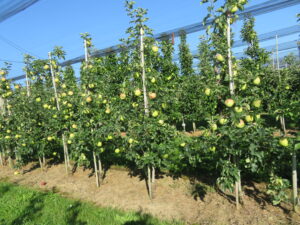
Polygenic resistance is generally governed by several genes, each with minor effects, and is also referred to as race-non-specific resistance. However, these effects act synergistically, thereby strengthening the overall resistance of the plant. Its impact on the pathogen can be observed as slower fungal growth, reduced spore production, and limited lesion formation. Over successive pathogen generations, the combined effect of these mechanisms results in a reduced rate of disease increase. Although polygenic resistance is not as strong as monogenic resistance, it provides a more stable defence, since pathogens find harder to overcome multiple small-effect genes (Image 2).
Breeding polygenic resistant varieties is much more challenging, as it requires extensive field evaluation and the use of molecular tools as markers, whereas breeding monogenic varieties relies on just a single marker.
New apple breeding programmes
New approaches towards variety breeding are applied to maintain the resistance efficacy and long-term durability. Successful resistance is the combination of several largely independent physiological defence mechanisms.
A single plant can exhibit both types of resistance. The monogenic resistance may be supported by polygenic resistance, extending its effectiveness over time – a strategy known as gene pyramiding.
In recent years, breeding programs such as those of the Institute of Experimental Botany (UEB) in Czech Republic (www.applebreeding.ueb.cas.cz) have focused on an integrated dual approach that combines polygenic and monogenic resistance in new varieties to ensure long-term durability. At the same time, emphasis is placed on quality traits such as fruit taste and appearance and tree productivity. The Institute is also renown for breeding columnar and red-fleshed varieties. Some of its varieties, as Opal® UEB 32642, Bonita or Melinda Dolcevita® UEB 6581, are traded as club varieties.
Four of the UEB newest varieties are already available for the apple producers from Moldova being marketed via Artevos GmbH. These varieties are:
• ORANGE CRISP [R] UEB 6481 [S] → scab (Rvi 6 resistance gene), powdery mildew and fire blight tolerance, orange-red very firm fruit with excellent spicy taste (Image 1)
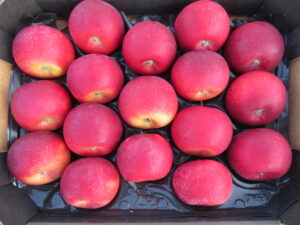
• ELLIPSO [R] UEB 47021 [S] → pyramidical scab resistance (Rvi6 + polygenic), fire blight tolerance, red spherical fruit with very good taste and high storability in ULO conditions (Image 3)
• CAMELOT [S] → polygenic scab resistance, powdery mildew and fire blight tolerance, red aromatic fruit with high storability and a slightly tangy taste (Image 5)
• LYRA [S] → scab polygenic resistance, powdery mildew and fire blight tolerance, yellow fruit with light orange blush and high storability and an outstanding flavour (Image 4)
Resistance to both apple major diseases, scab and powdery mildew
In 2025, at the Centre of Agricultural Technologies Augustenberg in Germany, no fungicides were applied in apple management trials in order to test varietal disease resistance. In Gala variety, 37% of leaves and 55% of fruits manifested visible scab symptoms, while 25% of young shoots were visually infected with powdery mildew. In Golden Delicious, the incidence was lower, with 25% of leaves and 35% of fruits affected by scab, 11% of shoots showing powdery mildew symptoms. By contrast, in Lyra and Orange Crisp® UEB 6481, all leaves, fruits and shoots remained completely healthy. For Ellipso® UEB 47021, no scab symptoms were observed, though about 5% of young shoots displayed visual powdery mildew symptoms in the absence of fungicide treatment.
Conclusion
In conclusion, breeding for scab resistance remains a cornerstone of sustainable apple production. While monogenic resistance through Rvi genes has provided important progress, its vulnerability to pathogen adaptation highlights the importance of polygenic resistance. The UEB program exemplifies the modern strategy of combining both approaches: maintaining useful monogenic resistances while expanding polygenic, quantitative resistance sources. Such efforts will be essential not only for ensuring durable resistance and reducing reliance on fungicides in orchards worldwide, but also for enhancing the sustainability, competitiveness, and profitability of fruit growing, as well as to produce healthy fruit.
Other Apple Varieties
Discover the entire Artevos selection now..
Click here for the variety overview.